- The 254 Report
- Posts
- From Hola Detention Camp 1959 to Central Police Station 2025: Kenyans Are Still Fighting for Accountability in Custody Deaths
From Hola Detention Camp 1959 to Central Police Station 2025: Kenyans Are Still Fighting for Accountability in Custody Deaths

Gerald Kombo
December 19, 2025
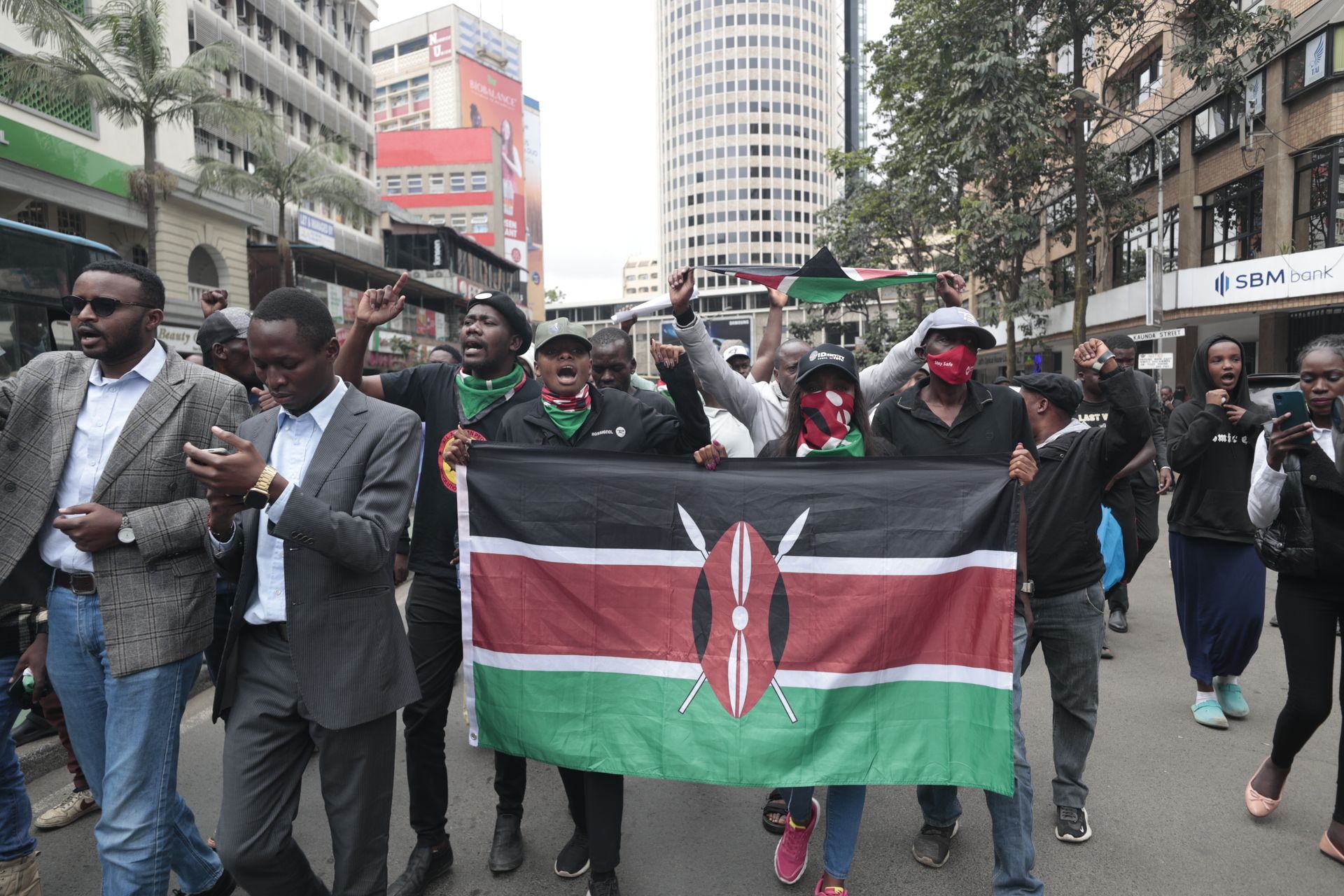
Gen Z protesters march with the Kenyan flag on Kimathi Street in downtown Nairobi, demanding accountability in custody deaths, June 2025. The street is named after Field Marshal Dedan Kimathi Waciuri, a commander in the freedom movement in Kenya who refused to surrender and was captured, tried and hanged by colonial authorities in 1957. Eliud Mutonyi Wanjie's manuscript records that such military titles were adopted by forest leaders "to enable them to command the respect of their juniors and maintain the discipline which was a cardinal feature in winning the war," embodying the movement's motto: say and act. (Photo by Henry Naminde for The 254 Report)
On March 3, 1959, eleven detainees were beaten to death at Hola detention camp. The colonial government blamed poisoned water. A manuscript by Eliud Mutonyi Wanjie, a detainee in the camp dispensary that morning, records what happened. In June 2025, blogger Albert Ojwang died in a Nairobi police cell. Same pattern: an official story that strains credibility, independent evidence that contradicts it, and accountability that stops short of senior ranks.
On March 3, 1959, Eliud Mutonyi Wanjie watched eleven men die under British warders' clubs at Hola detention camp. On June 7, 2025, blogger Albert Omondi Ojwang entered a police cell at Central Police Station alive and left as a corpse. Between these two deaths lies Kenya's independence, a new constitution, and multiple promises of reform. What has not changed is the pattern: someone dies in state custody, the government offers an explanation that does not match the evidence, independent investigators prove it false, and accountability stops at the lowest rank.
The evidence connecting these two events comes from a source not previously cited in journalism. A typewritten manuscript titled "Maumau: An Account of the Darkest Days of the Emergency," written by Mutonyi himself and held at the Kenya National Archives, records the internal organisation of the freedom movement in Kenya, the logistics of the Kapenguria trial, and the only known firsthand account of the Hola massacre. Sixty-six years later, the same pattern the manuscript documents, an official story that does not hold up, independent evidence that refutes it, and impunity for senior officials, recurred in a police cell in downtown Nairobi.

The cover of Eliud Mutonyi Wanjie's unpublished manuscript "Maumau: An Account of the Darkest Days of the Emergency," held at the Kenya National Archives in Nairobi.
What the Manuscript Reveals
Mutonyi's manuscript paints a detailed picture of an organised political movement. He describes a Central Committee meeting in Nairobi at Kiburi House, a secret body called Muhimu, and a War Council that coordinated strategy. The movement's motto in Kikuyu was Kuuga na Gwika, say and act, a rejection of leaders who talked but never risked anything.
"It was the colonial government and the settlers who called our freedom struggle 'Mau Mau'," he writes. "To us, it was the freedom movement in Kenya, organised through our own secret committees and councils, fighting for land, dignity and our rights as citizens."
The movement collected membership fees, administered oaths, and tried to police its own members. Anyone accused of misconduct away from home was sent back to their own area for judgment by people who knew them. Ranks such as general and field marshal were chosen locally by commanders who needed authority, not distributed from a central Nairobi office. These details describe a movement organised around internal discipline, not the criminal gang of colonial propaganda.
Before his own detention, Mutonyi was assigned to coordinate defence logistics for the Kapenguria trial of Jomo Kenyatta and five other leaders. The trial ran 58 days from November 1952 to March 1953. He managed an international legal team that included Mr Davies from Nigeria and Mr Chamalal from India. Two lawyers from India were refused entry at the border and turned back.
Barred from the courtroom, Mutonyi communicated with the accused using a coded Kikuyu exchange as they passed in chains. "I would ask them: Kuri o kuo? (Are you still alive/there?) One of them would ask us: Kuri noogo (Is smoke still there?) This way, unless one was a Kikuyu, the askaris would not know what was passing between us."
One prosecution witness, a woman named Peninah Wambui, refused to play her part. She had been brought to testify against the leaders, told what to say by police, promised money and a house. When called to the witness box, she said nothing the state wanted to hear. Declared a hostile witness, she was remanded with the accused. After the trial, Kenyatta handed her to Mutonyi, who rented a room for her in Nairobi and supported her until his own arrest.
Hola: What Mutonyi Saw
By early 1959, Mutonyi had spent five years in the detention camp system. Classified as one of "the blackest of the black," he was sent to Hola, a remote camp on the Tana River where the colonial administration held detainees they considered beyond rehabilitation.
On the morning of March 3, 1959, guards divided the detainees into three groups. One went to the kitchen. One, including Mutonyi, was ordered to the dispensary and told to squat with heads down. A third group of 85 younger detainees was taken to forced labour in the fields, ordered to dig irrigation furrows with hoes, basins and spades. Each detainee was guarded by five warders carrying rifles, sticks and batons.
From the dispensary, Mutonyi heard screams.
"The most agonising and ghastly screams I had ever heard in any camp, never for as long and with such awful intensity as that morning."
The warders beat the labour group in clusters of five. They whipped and kept whipping. When it was over, at least eleven men lay dead. Mutonyi watched their bodies carried into the dispensary where he was squatting. A young Red Cross doctor was so affected that he burst into tears and said it was not his job to treat corpses.
The men who died were:
Kabui Kaman, Ndungu Kibaki, Mwema Kinuthia, Kinyanjui Njoroge, Koroma Mburu, Karanja Munuthi, Ikeno Ikiro, Migwi Ndegwa, Kaman Karanja, Mungai Githi and Ngugi Karitie.
The colonial government announced that the men had died after drinking poisoned water. This story was repeated in Parliament in London and to the Kenyan public until medical evidence and outside investigations made it impossible to sustain.
After the massacre, the survivors were refused food for 19 days. The Red Cross doctor kept them alive with water. "The merciless colonial beasts at the camp asked him why he was bothering about us," Mutonyi writes. "He told them that he was only giving us water and that he was merely doing his job as a doctor for which he was paid by the government."
When the Governor, Sir Evelyn Baring, visited the camp, Mutonyi confronted him. Baring replied: "You are the worst Mau Mau and no one should have mercy upon you. You have lived with hard heads and have refused to co-operate with the government. Therefore, you will never be allowed to return to your Kikuyu country and you will perish right in here." Then he added: "Even if I found you dead, I could not have been worried a bit."
The camp was later removed from maps and renamed Galole, a change Mutonyi interpreted as a second attempt to bury what happened there.
A Teacher and Blogger Dies in Police Custody

Protesters in Nairobi demand justice for Albert Omondi Ojwang, a 31-year-old teacher and blogger from Homa Bay County who died in a police cell in June 2025 (Photo by Henry Naminde for The 254 Report)
On the night of June 7, 2025, teacher and blogger Albert Omondi Ojwang was arrested at his home in Homa Bay County. A senior police commander had filed a complaint accusing him of spreading false statements on social media. Police drove him more than 350 kilometres to Central Police Station on Harry Thuku Road in Nairobi and booked him into a cell late that night.
By morning, Albert was dead.
The first police statement said he had killed himself by hitting his head against the cell wall. Government pathologists recorded severe blunt-force injuries to his head, compression of his neck, and multiple bruises across his body. These findings were consistent with assault, not self-harm. The Inspector-General of Police later withdrew the suicide explanation and apologised for releasing false information.
"The deceased died as a result of severe head injury with neck compression and multiple soft tissue injuries, consistent with assault while in custody."
An investigation by the Independent Policing Oversight Authority found that cameras monitoring Albert's cell had been switched off or contained unexplained gaps. Prosecutors charged six suspects, three police officers and three civilians or fellow inmates, with murder. All pleaded not guilty. The case moved into a slow pre-trial phase.
Only junior officers and civilians appeared in court. The senior commander whose complaint triggered the arrest was not charged. The question of command responsibility remained a matter of public debate, not a matter for the courts.
The Protests and the Risk of Forgetting
News of Albert's death spread quickly. Young Kenyans organised demonstrations in Nairobi, Mombasa, Homa Bay and other towns. They marched with banners reading "Justice for Albert Ojwang" and chanted that no one should enter a police cell alive and leave as a corpse.
In central Nairobi, demonstrators carried the national flag between banks and office towers. Some wore bandanas and streetwear, others office suits. They recorded everything on their phones. At one point they staged a die-in, lying across the tarmac with Albert's portrait raised above them.
At his funeral, the procession turned into another march toward a nearby police station. Mourners chanted against deaths in custody and what they called a culture of impunity in uniform.
By December 2025, the protests had largely disappeared from national headlines. The court case dragged on. The pattern Mutonyi had documented in 1959, public outrage followed by silence, was repeating itself.
What Connects Hola 1959 to Central Police Station 2025
Mutonyi's manuscript preserves what the colonial state tried to erase: a story about poisoned water, a place removed from maps. The documents surrounding Albert Ojwang's death, post-mortem reports, IPOA findings, court files, protest photographs, do the same work for independent Kenya.
In Hola in 1959 and Central Police Station in 2025, the sequence is identical. Someone dies in state custody. Officials produce an explanation that contradicts the physical evidence. Independent investigators expose the falsehood. Accountability is directed downward, never upward.
The protesters who filled Nairobi's streets in 2025 carried banners demanding the end of deaths in custody. Their central demand, that words without action are worthless, echoes Mutonyi's motto. And the question his manuscript raises, about what happens when state detention sites are hidden from scrutiny, applies as urgently to a colonial camp on the Tana River as it does to a police cell on Harry Thuku Road.
The struggle over truth and accountability in Kenya did not end with independence. It entered a new phase. The question that remains, for both the colonial past and the democratic present, is whether Kenya's institutions will ever hold senior officials accountable for what happens to people who die in their care.
Frequently Asked Questions
What was the Hola detention camp massacre?
On March 3, 1959, British colonial warders beat eleven detainees to death at Hola detention camp in what is now Tana River County, Kenya. The government initially blamed poisoned water. Medical evidence proved the men died from beatings. A manuscript by Eliud Mutonyi Wanjie, a detainee present in the camp dispensary that morning, provides the firsthand eyewitness account.
Who was Eliud Mutonyi Wanjie?
Eliud Mutonyi Wanjie was a Kapenguria trial defence coordinator, a Central Committee and War Council member for Murang'a district, and a detainee present at Hola on March 3, 1959. His manuscript, held at the Kenya National Archives, is the only known firsthand account that covers the Kapenguria trial logistics, the War Council and Nairobi cell organisation, the oath administration hierarchy, and the Hola massacre eyewitness narrative. It has not been previously cited in journalism or published scholarship.
Who was Albert Omondi Ojwang?
Albert Omondi Ojwang was a 31-year-old teacher and blogger from Homa Bay County, Kenya. He was arrested on June 6, 2025, following a complaint filed by a senior police commander and died in a cell at Central Police Station, Nairobi. Government pathologists found injuries consistent with assault, contradicting the initial police claim of suicide. Six people have been charged and denied bail.
What links Hola 1959 to Central Police Station 2025?
Both cases follow the same pattern: someone dies in state custody, officials offer an implausible explanation, independent evidence exposes the falsehood, and accountability stops at junior ranks. In Hola, the colonial government blamed poisoned water. In 2025, police blamed suicide. Both explanations collapsed under independent evidence, and no senior official faced consequences.
Reply